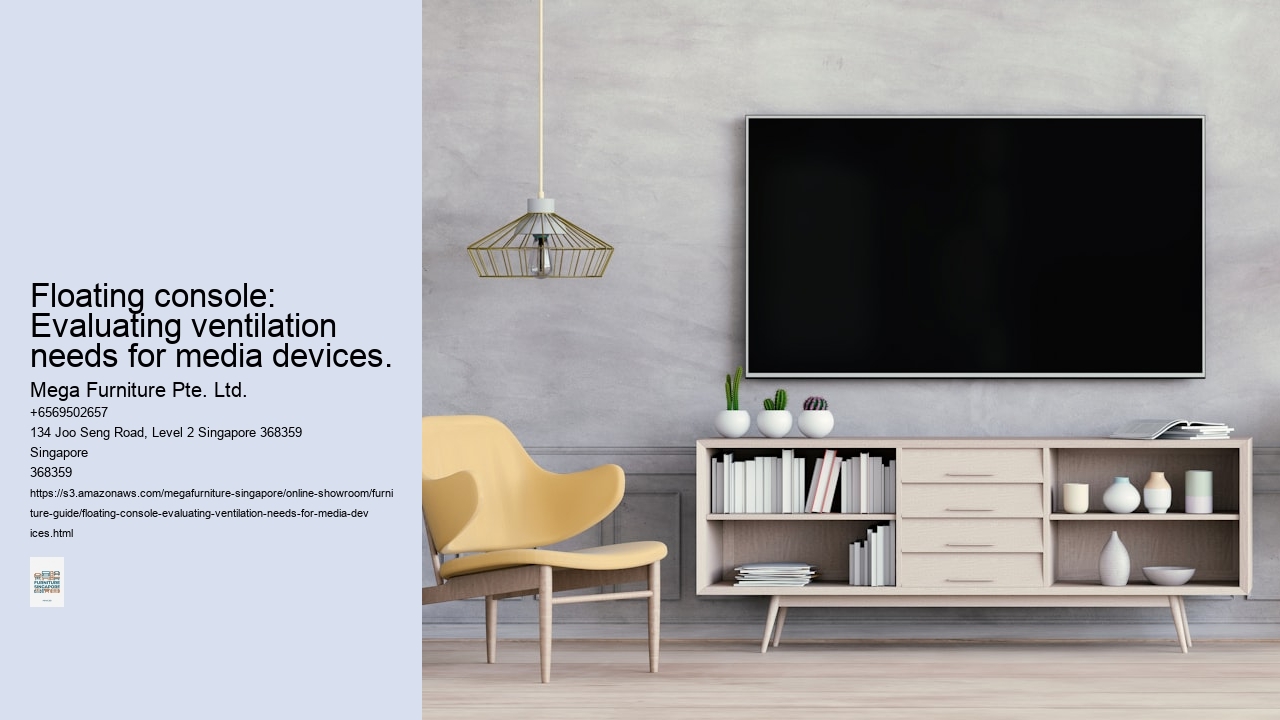
The PlayStation’s exhaust fan spins up, pushing hot air directly into the back panel of a solid MDF console—and that’s when the trouble starts in a Bedok flat at 85% humidity. It’s a common, expensive mistake: treating a media console like a sealed cabinet for books. Modern devices are space heaters with circuit boards, and they’ll quietly cook themselves without a dedicated escape route for that waste warmth. Passive airflow isn’t a luxury here; it’s non-negotiable. You’ll want rear cable grommets, those oversized rubber-lined holes that do double duty by organising cords and letting hot air seep out. Better still is an open-back design, which turns the entire rear of the console into a ventilation shaft. For particularly packed setups with an AV receiver, a gaming console, and maybe a set-top box all stacked together, an integrated low-RPM fan isn’t overkill—it’s basic insurance against premature failure. The local climate makes this critical. Singapore’s persistent dampness means trapped heat doesn’t just stress components; it creates a warm, moist microclimate perfect for condensation. That combination accelerates corrosion on internal contacts and can lead to intermittent faults that are a nightmare to diagnose. A solid back panel might look neater during a showroom visit, but it actively works against the physics of your devices. So, when evaluating a floating console, your first question shouldn’t be about finish or length. It should be about where the heat goes. Run your hand behind the unit in the showroom; if you can’t imagine a clear path for air to travel from the front intake to the rear exit, keep looking. Good design here is invisible, a series of calculated voids that let your gear breathe. For options that prioritise this, you can browse
Megafurniture's TV console collection, paying close attention to the rear-panel specifications. Ultimately, the goal is to avoid creating a miniature sauna at the heart of your media wall. Think of it as climate control for your electronics—because the ambient air outside the cabinet is already doing enough.
Singapore's humidity, often hovering around 80%, quietly degrades cheap substrates. Particle board or MDF cores swell at the edges when moisture seeps in, causing laminates to peel and warp over a console's lifetime. Moisture-resistant plywood, typically Baltic birch or marine-grade, offers a far more stable foundation; its cross-banded layers resist expansion under daily humidity cycles. That structural integrity matters most for floating mounts, where any core deformation can stress the wall brackets. It's a long-term investment that prevents the sagging middle shelf or the door that won't close properly two years in.
Melamine finishes, especially high-pressure laminates with textured patterns, provide the scratch resistance families need. A cat's claws or a child dragging a toy across the surface won't leave permanent marks, unlike softer veneers or painted solid wood. The best versions are rated for commercial use, offering a wear layer that withstands cleaning chemicals and frequent wiping without dulling. Look for a minimum thickness of 0.5mm for the laminate itself—thin coatings chip easily at corners. This armour is non-negotiable for consoles in active living rooms, where the surface is both a functional shelf and a display platform.
Sturdy metal brackets, not plastic or thin aluminium, are the unseen heroes of a floating console. They must support not just the cabinet's weight, but also a 65-inch TV, soundbars, and the occasional leaned-on elbow. Heavy-gauge steel brackets with multiple wall-fix points, often six or more, distribute load across a wider area of the HDB wall. Poor hardware leads to that unsettling creak when you place a new gaming console on the shelf, or a gradual forward tilt. It's a component where over-specifying pays off, ensuring the unit stays level and silent for a decade.
Solid wood, while beautiful, is a temperamental choice for our climate. It continually absorbs and releases moisture, expanding in the rainy months and contracting during drier periods; this movement can crack joints or twist longer spans. Even kiln-dried oak or teak needs a controlled environment, which most HDB living rooms simply don't provide. That's why solid wood consoles, unless expertly sealed and acclimatised on-site, often develop gaps or become uneven over time. For a floating install, where the frame can't adjust, this inherent movement risks the entire mount's stability.
Every panel edge, especially at the back near wall moisture and underneath near floor cleaning, requires a proper seal. Water-resistant plywood cores still need their edges banded or laminated to prevent micro-gaps that invite humidity ingress. A fully wrapped edge, where the finish material covers the entire panel perimeter, is more effective than just a front-facing veneer. This detail is often overlooked in cheaper units, leading to localised swelling at the rear corners that's only discovered when moving the console. Consistent sealing turns a moisture-resistant panel into a truly durable one.
A 65-inch television perched on a 120-centimetre floating console looks exactly like what it is: a precarious afterthought. The proportion is off, creating that top-heavy wall the brief warns against—a common misstep in a 4-room BTO where every millimetre counts. Getting the console width right isn't just about aesthetics; it’s a fundamental stability calculation.
For a balanced look and to properly anchor your TV, the console should exceed the screen’s width by 20 to 30 centimetres. That means a typical 65-inch TV, with a width around 145cm, needs a cabinet roughly 160 to 175 centimetres long. This overhang provides visual weight and, crucially, a stable base that prevents the entire wall from feeling like it might tip forward. It’s a simple rule that solves two problems at once.
Depth is the second, often overlooked, dimension. Modern AV receivers and amplifiers can be deep—40 centimetres or more—so a shallow console simply won’t do. You’ll need a depth of at least 45cm to house the gear comfortably, but then you must consider the room itself. In a narrow HDB layout, perhaps a long corridor-style living room common in older flats in Bedok or Tampines, a console that’s too deep can choke the walking space. Aim for a depth that accommodates your deepest component while leaving at least 80cm of clear passage in front.
Ultimately, sizing is a negotiation between the TV’ proportions, your equipment’s bulk, and your room’s footprint. A well-proportioned console becomes a deliberate architectural element, not just a slab to hold things. For those measuring up, the floating console range at Megafurniture offers a variety of lengths and depths that can help you hit these specific targets without custom work.
A photo of a laminate finish online might look like solid walnut; under the fluorescent lights of a typical HDB corridor, it can read as plastic. That’s the first reason to visit a showroom — colour fidelity. Singapore’s specific light, a mix of harsh afternoon sun and cool LED downlighting, reveals undertones you’ll never see on a calibrated monitor. You’re not just buying a colour; you’re buying how it behaves in your four-room BTO at 7pm.
Beyond colour, there’s the matter of substance. You can’t assess a drawer slide’s smoothness from a product video, or feel the sharpness of a laminate edge that will snag clothes for years. Testing the action in person tells you more about longevity than any spec sheet. More critically, you can confirm the actual robustness of mounting brackets and the console’s internal frame — a non-negotiable for wall-mounting over a tiled floor, especially in BTO drywall where weight limits are a genuine concern.
Showrooms let you judge finish tolerances up close. Does the veneer align perfectly at the corners, or is there a slight overlap? Is the sintered stone top perfectly flush with the wooden frame? These are details that define a premium piece from a problematic one, and they’re invisible in staged lifestyle shots. It’s the difference between a unit that feels integrated into your media wall and one that looks like a collection of parts.
Ultimately, a floating TV console is a commitment to your wall and your daily view. The half-hour trip to a local showroom, to physically touch laminate edges and test drawer slides, mitigates the risk of a costly mismatch. You’ll leave with a concrete understanding of proportion and presence, something a digital cart can never provide. For a hands-on assessment of the options, browse Megafurniture’s collection at their Joo Seng or Tampines showrooms.
That long, flat box won’t always fit in the lift. HDB lift landings are notoriously tight, often restricting crates longer than 200cm; your 240cm console might need a staircase carry, and delivery crews typically charge an extra $80 to $120 for the manual haul up multiple floors. Always verify these logistics beforehand—ask for crate dimensions and confirm whether the quoted delivery fee includes doorstep or actual in-home placement. It’s a frustrating but common oversight in many BTO blocks, where that final metre of corridor can become a very expensive problem.
Assembly is where the real commitment begins. A floating console must be anchored to studs or, better yet, directly into solid concrete or brick; the hollow knocking sound behind many partition walls spells trouble for anything heavier than a picture frame. Professional installers will use a stud finder and masonry drill bits to secure a robust mounting rail, which distributes the console’s weight and the load of your AV equipment. DIY attempts often underestimate this, relying on plasterboard plugs that can pull out under the sustained weight, leaving you with a catastrophic failure months later.
That’s why the warranty fine print matters. Most cover surface defects like chipped laminate or faulty drawer runners, but you need confirmation it extends to the structural integrity of the wall-mounting system itself. If the bracket fails or the cabinet sags away from the wall, you don’t want to be told it’s an installation issue. A reputable retailer should offer a clear warranty on the mounting hardware and frame, acknowledging that this piece is a permanent fixture, not just free-standing furniture.
For a secure selection of wall-mounted options designed for local homes, browse Megafurniture’s collection. Beyond just getting it up, consider the daily use: a well-mounted console should feel like an extension of the wall, with no discernible flex when you place a heavy bookshelf speaker or lean on it to connect a cable. That solidity is the quiet payoff for navigating the delivery and assembly logistics correctly—it’s what turns a purchased item into a permanent, dependable part of your living room.
A 240cm floating console looks grand in a showroom, but it'll swallow a 3m wall in your four-room BTO flat. That leaves just 30cm on each side — barely enough for a floor lamp, and it visually dominates the room. The proportion feels off, like a too-large painting crammed into a small frame. Many buyers fixate on matching console length to TV size, forgetting that wall space dictates furniture presence more than screen dimensions; a 180cm console often balances a 75-inch TV better in a compact living room, leaving breathing room for shelving or a plant.
Then there's the clean look that turns messy after installation. Floating consoles promise a sleek, uncluttered silhouette, but that's defeated instantly if a tangled web of HDMI, power, and LAN cables dangles beneath. Ignoring integrated cable management — rear access panels, internal channels, or a dedicated back slot — is a classic error. You'll end with a minimalist design sabotaged by technical clutter, a common sight in condo media walls where the focus was purely on finish, not function.
Perhaps the most critical oversight is assuming all walls can bear the load. Many BTO and resale flat walls are hollow partition walls, not structural concrete; a loaded 240cm console filled with media equipment and books can weigh over 50kg. Mounting it without proper reinforcement risks a catastrophic failure — it's not just about finding studs, but confirming the wall's core material and using appropriate anchors. That reinforcement step, often skipped to save time or cost, is where many renovations stumble.
These mistakes compound in compact spaces where every centimetre and visual line counts. The right console isn't just about storage or style; it's about fitting the room's physical and visual scale, hiding the inevitable wires, and securing it to what the wall actually is, not what you hope it to be. For options that address these practicalities, you can browse Megafurniture's collection, which includes designs with thoughtful cable management and clear mounting specifications.
A 55-inch TV is the new standard for a 4-room BTO living room, but the question that stops many buyers mid-click is whether a floating console can actually support the weight of a screen that size plus a soundbar. The short answer is yes, if you select a model designed for it — look for a console with a stated weight capacity of at least 50kg and a top panel that’s at least 150cm long, which provides a stable base that extends beyond the TV’s legs. That extra length is crucial; it prevents the setup from looking top-heavy and gives you space to centre the soundbar without it overhanging the edges.
Hiding the router and a tangle of power strips is the real test of a clean media wall installation. Most floating consoles achieve this with a combination of cable management ports at the back and deep, full-height compartments at one end — you can stash a router and a multi-plug inside, then feed only the necessary cables out through the grommets. For a truly seamless look, some homeowners run a dedicated power outlet behind the console itself, which eliminates visible cords entirely; if you’re doing a full renovation, it’s a detail worth discussing with your ID.
Wall-mounting safety with young children is a valid concern, but it’s more about the wall and the fixings than the furniture unit. Any reputable console will include a robust mounting bracket, but its security depends entirely on hitting the solid concrete structural wall behind the plaster, not just the partition. Use a stud finder or, better yet, get your contractor to confirm the wall type; proper concrete anchors will hold firm against any accidental bumps or tugs, turning a potential hazard into one of the more stable pieces in the room.
Lead times for non-stock colours like olive green or matte charcoal typically add two to four weeks, as these are often made to order after you commit. That’s a standard timeline across local furniture, so if you’re working to a tight renovation schedule, it’s a factor you’ll need to build in. The wait is usually for the finishing process, not the build, which means you can often confirm the final dimensions and mounting plan well before the unit arrives for installation.
A buyer's excitement over a floating console's clean lines often evaporates when they realise their specific HDB feature wall is 12cm shorter than the standard 240cm unit they'd picked out. It's a common oversight, and it leaves a gap that no amount of decorative vase placement can convincingly hide. Before you commit, physically measure your intended wall space, including any skirting boards or architectural protrusions; then, cross-check those numbers against the console's exact listed dimensions, not just the product title. The right fit isn't just about the console looking centred – it's about it looking like it was always meant to be there.
Ventilation design is another silent deal-breaker. That sleek, closed-back floating unit might look perfect under your 75-inch OLED, but if it traps the heat from your media player, game console, and soundbar, you're essentially building a small oven into your wall. Look for models with strategic rear cable grommets that double as air channels, or consider a design with a perforated metal back panel behind the main equipment bay. In a typical 4-room BTO living room, where afternoon sun can already raise the ambient temperature, passive heat dissipation isn't a luxury – it's a necessity for your electronics' lifespan.
Then there's the installation itself. A true floating console, especially one loaded with gear, needs to be securely anchored to studs or with proper wall plugs into solid brick. If professional installation isn't bundled, factor in the cost and hassle of finding a reliable handyman – because a wonky, sagging console defeats the entire aesthetic purpose. It's worth confirming what the quoted price includes; a proper install should involve a site visit or at least a detailed guide on wall type requirements.
Ultimately, the final check is about reconciling that floaty, minimalist look with the very practical realities of heat and stuff. You want a console that disappears visually but performs diligently, hiding cables and game controllers while letting your AV equipment breathe. It's a balancing act between form and a very specific function. For a wide range of lengths and styles that cater to this balance, you can browse the options at Megafurniture's collection.
So, take a final walk-through: measure the wall one more time, trace where every device will sit and vent, and read the installation fine print. That moment of diligence is what separates a seamless media wall from a daily reminder of a compromise.
The standard 4-room BTO living room offers a clean, uninterrupted wall of around 3.6 metres-a blank canvas that practically begs for a long, low-slung console. That same 180-centimetre floating unit, however, will dominate a compact 3-room resale flat, where corridor-style layouts and awkwardly placed doors carve up the available wall space. A TV console anchors the wall opposite the sofa in the same way a tall bookshelf anchors a corner — long horizontal piece, mix of open and closed storage, defines the visual weight of one whole side of the room. Megafurniture's TV Console range covers floating wall-mounted designs, low-profile freestanding consoles, and modular feature-wall configurations. Most pieces sit at 40-50cm height, sized for screens up to 75 inches.. Your housing type doesn't just suggest a console size; it dictates it. Corridor-style resale HDBs present a particular challenge, as the main living area is often a thoroughfare. A protruding floor-standing unit can shave precious centimetres from the walkway, turning a cosy space into an obstacle course. Here, a shallower floating console, perhaps 35 centimetres deep, becomes a functional necessity-it keeps the path clear while still offering a ledge for the TV and some discreet storage for routers and game consoles. Condo owners with open-plan layouts face a different calculus. That sweeping feature wall might accommodate a 240-centimetre media unit, but its minimalist aesthetic demands careful proportion; an overly bulky design can look heavy against expansive windows. The choice often comes down to anchoring the space with a substantial piece or maintaining an airy feel with something more streamlined-it's a trade-off between presence and perceived square footage. Before you commit to any dimensions, get the tape measure out. Account for the swing of balcony doors in newer BTOs, or the off-centre electrical points in older flats that might force your console into a lopsided position. A unit that's 20 centimetres too long can mean it butts against an air-con trunking or blocks a switch, ruining the clean lines you're after. The right console should look like it was built for the wall, not just placed against it. For those navigating these spatial puzzles, browsing a comprehensive
TV console collectioncan help visualise the range of lengths and depths that might work. You'll find that a 140-centimetre model often fits a 3-room niche perfectly, while the 200-centimetre options anchor a spacious condo living room without overwhelming it.
The standard 4-room BTO living room offers a clean, uninterrupted wall of around 3.6 metres—a blank canvas that practically begs for a long, low-slung console. That same 180-centimetre floating unit, however, will dominate a compact 3-room resale flat, where corridor-style layouts and awkwardly placed doors carve up the available wall space. Your housing type doesn’t just suggest a console size; it dictates it. Corridor-style resale HDBs present a particular challenge, as the main living area is often a thoroughfare. A protruding floor-standing unit can shave precious centimetres from the walkway, turning a cosy space into an obstacle course. Here, a shallower floating console, perhaps 35 centimetres deep, becomes a functional necessity—it keeps the path clear while still offering a ledge for the TV and some discreet storage for routers and game consoles. Condo owners with open-plan layouts face a different calculus. That sweeping feature wall might accommodate a 240-centimetre media unit, but its minimalist aesthetic demands careful proportion; an overly bulky design can look heavy against expansive windows. The choice often comes down to anchoring the space with a substantial piece or maintaining an airy feel with something more streamlined—it’s a trade-off between presence and perceived square footage. Before you commit to any dimensions, get the tape measure out. Account for the swing of balcony doors in newer BTOs, or the off-centre electrical points in older flats that might force your console into a lopsided position. A unit that’s 20 centimetres too long can mean it butts against an air-con trunking or blocks a switch, ruining the clean lines you’re after. The right console should look like it was built for the wall, not just placed against it. For those navigating these spatial puzzles, browsing a comprehensive
TV console collectioncan help visualise the range of lengths and depths that might work. You’ll find that a 140-centimetre model often fits a 3-room niche perfectly, while the 200-centimetre options anchor a spacious condo living room without overwhelming it.